Norcombe Hill
Far from the Madding CrowdNorcombe Hill is a chalk down that gathers several decisive turns in Gabriel Oak’s life: he first sees Bathsheba Everdene there, establishes himself as a sheep farmer on its slopes, and loses his flock when his young sheepdog drives the ewes over the edge of a chalk-pit. The hill’s enduring shape contrasts with the precariousness of the people and livelihoods upon it. It is at once a working landscape, a vantage point from which human action is observed, and a place Bathsheba later recalls as the scene of her unencumbered independence.
Setting and Character
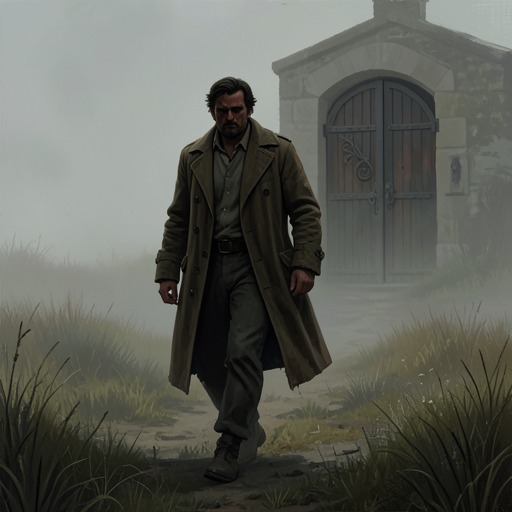
Norcombe Hill is described as a featureless convexity of chalk and soil, near lonely Toller-Down. Its northern side is covered by an old, decaying beech plantation, whose upper edge traces the crest; the open hill commands a distant horizon. That combination of exposed height and sheltering wood gives the place a distinctive physical character. The hill seems almost immune to change, while wind, stars, animals, and people move across it.
In winter, the hill becomes an instrument for registering weather. On a clear night near St. Thomas’s Eve, north winds buffet the beech wood and cross the grass in gusts of changing force. The narrator dwells on the stars’ motion and the sensation of the world turning beneath them. Against this expansive scene, the small shepherd’s hut under the plantation hedge appears almost toy-like. The contrast makes the hill both intimate and immense: a place where a shepherd can attend closely to his flock beneath a sky that seems to carry the whole earth along.
Oak’s Farm and the Work of the Hill
Norcombe Hill formed part of the small sheep farm that Oak had leased during the preceding year. He had stocked it with two hundred sheep, buying them on credit after earlier work as a bailiff and shepherd. His move from hired service to farming on his own account was a consequential risk, and he knew the lambing season would test it. Rather than entrust the work to a novice or hireling, he personally kept watch over his ewes, using the skill he had acquired through a lifetime among sheep.
The hill’s farming landscape was organized around that labor. A shepherd’s hut on wheels could be drawn into the fields for the lambing season, when night attendance was required. Oak’s slow, deliberate movements among the flock express both physical fitness for the work and a temperament grounded in patience rather than display. The place establishes him not simply as a picturesque shepherd but as a skilled, self-reliant worker attempting to become a farmer in his own right.
The Chalk-Pit and the Loss of the Flock
On the far side of the hill, two hedges converged in a V near an old chalk-pit, leaving a narrow opening above the precipice. A rough railing protected the edge. The arrangement becomes the setting for the catastrophe that destroys Oak’s new farm. One night, after leaving both dogs on the hill beside a dead lamb, Oak returned home believing his attendance was no longer needed. Before dawn, the flock’s bell sounded with the rapid, regular pulse he recognized as a sign that the sheep were running.
Oak found a break in the hedge and followed the animals’ tracks across the hill. The two hundred ewes that had not yet lambed were missing; the fifty ewes already enclosed with their lambs remained where he had left them. At the chalk-pit he found the young dog standing beside the broken railing. The sheep lay below, dead or dying, their bodies a heap of mangled carcasses. The dog had misunderstood his task: eager to drive sheep, he had gathered the ewes, worried them forward, and forced them over the precipice. The place turns an ordinary risk of animal handling into a sudden disaster, with the landscape’s familiar features—hedge, track, and railing—becoming the path to ruin.
Oak’s immediate response is pity for the ewes and their unborn lambs. Only afterward does he register the financial consequence: the flock was uninsured, and his savings had been spent on the venture. His prospects of independence collapse. In the aftermath, he gives thanks that he is unmarried and therefore will not bring a wife into the poverty now facing him. The hill is thus where economic ambition, humane feeling, and vulnerability meet; its familiar working ground exposes how little separates a farmer’s hard-won progress from loss.
Memory, Weather, and Narrative Significance
The hill also frames Oak’s first sight of Bathsheba. On a mild December morning, he looks over a hedge and sees a yellow spring wagon halted on the incline, loaded with household goods, plants, a caged canary, and a cat. While the carter goes back for the missing tailboard, Bathsheba takes a small swing looking-glass from a parcel and examines herself. The scene places her self-regard within an ordinary moment of travel, as Oak watches from the landscape where his own working life is taking shape.
Later, when Bathsheba’s marriage to Sergeant Troy has brought her despair, she wishes she could stand again on Norcombe Hill as she once did, able to defy Troy or any other man to interfere with her. The remembered hill is not simply a refuge from the present: it represents the independent confidence she associates with her earlier self. When she and Oak finally walk together to the church to marry, she has arranged her hair at his request as she wore it years before on Norcombe Hill. The remembered appearance links the marriage to the first encounter without erasing what has intervened.
Norcombe Hill’s narrative force comes from this recurrence, but also from its material continuity. Oak’s professional hopes, the loss of his uninsured flock, Bathsheba’s first appearance, and her later recollection of independence all belong to a landscape shaped by ordinary rural work and exposed natural conditions. The hill does not decide the characters’ choices; it gives those choices a setting where consequences become visible—in the path of sheep, the edge of a pit, the labor of lambing, and the enduring image of a woman standing free on its slope.